

A basket of berries
Would you say yes?
Magdalena
12/22/2024

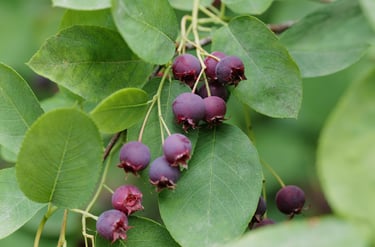
Photo by Georg Eiermann on Unsplash
I tend to be thrilled, to break a little dance even, when I discover something that speaks my language. I’d like to imagine for a second the person writing that very book that talked to my soul, that singer or lyrics writer who tenderly pours their heart into a song that I will play on repeat for days and days. I’d like to imagine - would I resonate the same way if I would meet them? I would say yes. Today.
I felt a lot of times out of place at book signing or meeting creators whose art inspired me. There are good magic memories there too, yet, I tend to feel suddenly shy. I am sure is not only me. I forget everything about the book, I forgot what I loved most about the art, I transition into a blank space. It might happen to more people that I imagine. Let’s say, if I would meet Suleika Jaouad today, I would tell the story of listening to her book on the rooftop of my guesthouse. I would tell the story of hearing about her from Jon Batiste’s speech. I would tell her how much I love these chain reactions. I knew nothing about them seven years ago or so. So happy to be smitten with their work and humanity today. So humbled every single time I read a story or listen to a tune created through them.
At the first glance there is no relation between any of above and a basket of berries.
Until i start to unveil how this all started.
Once upon a ferry ride to Central, I was trying to find a book to inspire me. A quiet winter solstice was slowly making its way to our eastern shores and somehow it was sending some signals to articulate more what runs deeper within me. Yes, these were exactly my feelings and thoughts while soaking up the morning sun rays floating on the sea. Christmas holidays around the corner, a generous and abundant atmosphere, a time that cheers me up. I would have to admit, there were some conflicting ideas around my head and was wondering what is too much, was it too little, was it enough. Everything being relating, of course it will reflect based on everyone’s perspective. And here I was on this boat, a bit worried in fact about my own ways of understanding generosity and sharing.
Checking my Audible application for an author to find me, to speak to me, to understand me perhaps, I came across this book called”The Serviceberry” by Robin Wall Kimmerer. I believe I must have taken a note during a podcast. The book is dedicated to her neighbours. And it starts with this paragraph “All flourishing is mutual”.
I could not be more hooked! I deep dived and listened and listened. And I also purchased the digital version as this gorgeous gem of a book needs to be highlighted at large.In my universe at least.
The Serviceberry,Abundance and Reciprocity in the Natural World
The book introduces us to the origins of the berries, the family they are part of, and gets us right away into the root words in Potawatomi that contain also the same root word for “gift”.
In Potawatomi ,it is called Bozakmin ,which is a superlative:the best of the berries. […]For me, the most important part of the word Bozakmin is “min” ,the root for “berry”. It appears in our Potawatomi words for Blueberry (Minaan), Strawberry (Odemin), Raspberry (Mskadiismin), even Apple( Mishiimin), Maize (Mandamin) and Wild Rice (Manomin). That world is a revelation because it is also the root word for”gift”. In naming the plants who shower us with goodness, we recognize that these are gifts from our plant relatives, manifestations of their generosity, care and creativity. James Vukelic, an Anishinaabe linguist, teaches us that these plant gifts are “a manifestation of unconditional love that plants have for people”. Plants offer whatever they have, to whoever needs it, “saint and sinner, alike” he writes.
We continue to learn that in the Anishinaabe worldview, all the sustenance that the land provides, from fish to firewood ,everything that makes our lives possible,” is provided by the lives of more-than-human beings.
“When we speak of these not as things or natural resources or commodities, but as gifts, our whole relationship to the natural world change. “
A very simple example to keep forever in our mind would be : should you receive a basket of berries from your neighbour, you would probably make a pie with them, or in our country we would make berry preserve and most probably we would share back with the same neighbours or others. It would not be only for ourselves. There is a sense of responsibility, a reverence, appreciation and we would feel compelled to also share something back. Perhaps on another day we would knock at the neighbours door and share another produce from our garden. Luckily on my side,I grew up in such community based on sharing. Food, produce, meals, bread, polenta and cheese. I could still remember those days when we were bouncing back from our place to the neighbours, or at my grandmothers’ someone will bring a plate of milk porridge, or pears or some cuts of a meat … there is a continous give and receive and do something with it and give again. Pay forward, pay back in the most natural way, following the seasons just like Robin so eloquently describes.
The book goes deeper. It tackles the definition of economics- as the study of scarcity and its implications for the use of resources. Studies production, distribution and consumption of goods and services. It is related to making profit. It is transactional.
While in communities, the focus is on the good of the people, not individually focused.
The author continues so vividly:
“Water is life, food is life, soil is life- and they become our lives through the paired miracles of photosynthesis and respiration. All that we need to live flows through the land.It is not an empty metaphor that we call her Mother Earth.Food in our mouths is the thread that connects us in a relationship simultaneously spiritual and physical, as our bodies get fed and our spirits nourished by a sense of belonging, which is the most vital of foods. I have no claim to these berries, and yet here they are in my bucket, a gift. “
I kept listening in awe - how can we be that related in time and space from one corner of a world to another. Robin talks then about gratitude as a “culture”. Culture of gratitude where we have recognition and responsibility for the earthly gifts.
“Enumerating the gifts you’ve received creates a sense of abundance, the knowing that you already have what you need. Recognizing ”enoughness “ is a radical act in an economy that is always urging us to consume more”.
This should be integrated in the the economics lessons we are taking in school, in college. It might not be the only category of economics, but it should be one. The economics of abundance instead of scarcity as a starting point. The economics of having enough.
The dilema I was having earlier in my own mind, was heavily rooted in the fact that despite understanding this well and having brought up in the same very spirit, it is quite hard to renounce some of these habits. I do believe in enoughness. I do believe in sharing and practice it religiously. Some good work remain to be done in a simple inclination to get maybe a bit more to stock up the fridge. It is a skeleton in my closet - for sure. A battle that I am persistently approaching. A battle I would like to focus on in the years to come. One way I saw helpful for me is pretty much to give up categories of food, and step by step focusing on much fewer groups.
Running to catch a boat back home during the workweek I only spin through a market super quickly and pick up 2-3 things to cook fresh and back to running. It has helped me a lot to approach focus in a different way - like with the seasons. Adapting the new life, in this village with all its changes. Hoping that my neurons also might generate new pathways to embed enoughness into all choices I make.
It is a mountain to tackle. And thankful to this brilliant and inspiring book, I would love to find new creative ways.
As a wish for this winter solstice, a garden with vegetables patches and fences of berries would be my visualisation exercise right now.
Thank you,Robin.
Thank you all lovely friends for listening…..
Gift away, bring berries, make pies and jam, sing carols and take all there is in with deep gratitude.

© 2026 OneKindVoice. All rights reserved.
Keep in touch
Subscribe to our newsletter for updates


